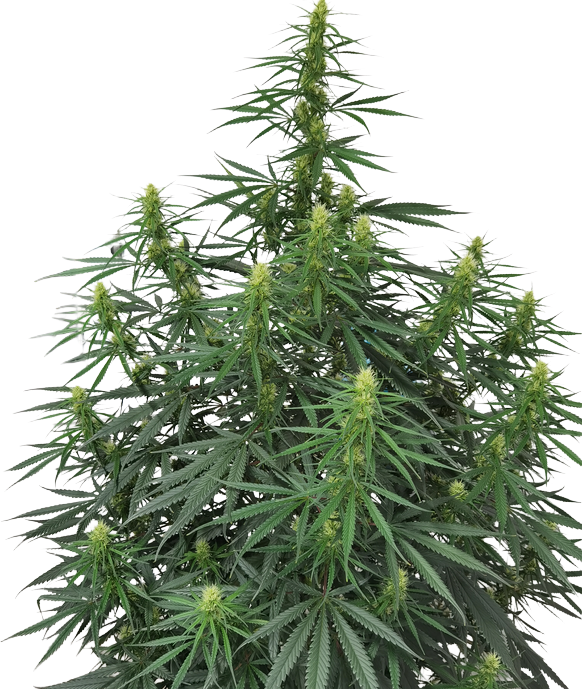
What Makes It Special
The traits that define true Haze genetics are the traits that make them difficult. The plants grow tall — very tall — with loose, open branching that maximizes light interception in the equatorial environments their parent genetics came from. They take a long time to flower, often fourteen to sixteen weeks from induction, and they don't produce the dense, heavy yields that indoor commercial cultivation demands. The resin develops slowly and incompletely if the season is cut short.
But in the right conditions, given the full time they need, the aromatic and chemical complexity that develops is unlike anything the short-season cannabis market produces. The terpene profile that emerges over a long, slow flower — the woody, incense-like base notes, the bright citrus and spice overlays, the clean green top — reflects the full expression of four distinct sativa lineages working together. It cannot be rushed. It cannot be abbreviated. It is, in a real sense, irreducible.
Why the Market Moved On
The indoor cannabis market of the 1980s and 1990s had clear priorities: high yield, short flowering time, uniform plants that could be managed at scale under artificial light. Haze met none of these criteria. The response from commercial breeders was to cross Haze with faster, denser indica varieties — particularly Northern Lights and Skunk — producing hybrids that retained some Haze character while finishing in a commercially viable timeframe.
These crosses — Haze x NL5, Super Silver Haze, Amnesia, and dozens of others — have real value. They made Haze genetics accessible to a much wider range of growers and helped preserve at least part of the genetic heritage. But they also represent a compression. The full expression of what Haze could do was traded for what Haze could do in ten weeks under lights. It's a reasonable trade for a commercial market. It's a significant loss for anyone who cares about the full range of what cannabis genetics can express.
Meanwhile, the original Haze populations — maintained by a small number of committed collectors and breeders who understood what they had — became increasingly rare. Seeds changed hands infrequently and quietly. The original genetics drifted through inbreeding and neglect. Much of what circulates today as "original Haze" is several generations removed from the founding population, with all the genetic narrowing that implies.
The Work We're Doing
What we can do is work with Haze genetics that trace as directly as possible to the original population, maintain population size to minimize genetic drift, and resist the pressure to select for commercial traits at the expense of the genetic diversity that makes Haze worth growing in the first place.
The Haze OG cross we've developed brings Haze structure together with Kush grounding — not to make Haze easier, but to make it more stable across a wider range of conditions without losing what makes it distinctly Haze. It still takes time. It still wants space. It still rewards patience in ways that faster genetics simply don't.
The Haze Slurricane and ECSD × Haze Slurricane crosses take the genetics in a different direction — exploring what happens when Haze's structural expressiveness meets the fruit-forward character of more recent American breeding. These are not preservation projects in the strict sense. They're active exploration, using Haze as a foundation to see what it can become in new combinations while keeping the core character intact.
Why It Matters Beyond Nostalgia
There's an easy way to frame interest in Haze genetics as nostalgia — as collectors chasing something their parents or grandparents might have encountered, more about sentiment than substance. That framing misses the point.
The genetic complexity encoded in Haze represents decades of selection from four distinct sativa populations, each of which represents its own centuries of local adaptation. The chemical and aromatic diversity that full-term Haze expresses is a product of that complexity. We don't fully understand the relationships between the hundreds of compounds involved in that expression. We don't know what we lose when we narrow the genetic base.
What we do know is that genetic diversity, once lost, is not recovered. The Haze genetics that exist today — in their most complete form — exist in a small number of collections. The pressure to hybridize, to stabilize, to make them commercially viable continues. Every generation that passes without deliberate maintenance is a generation of potential lost.
That's the argument for this work. Not nostalgia. Not sentimentality. The same argument plant geneticists make about food crops, about forest trees, about any complex living system: you don't know what you'll need until you need it, and by then it may be too late to go looking.
Now available